

Passover: A Diminished Cup
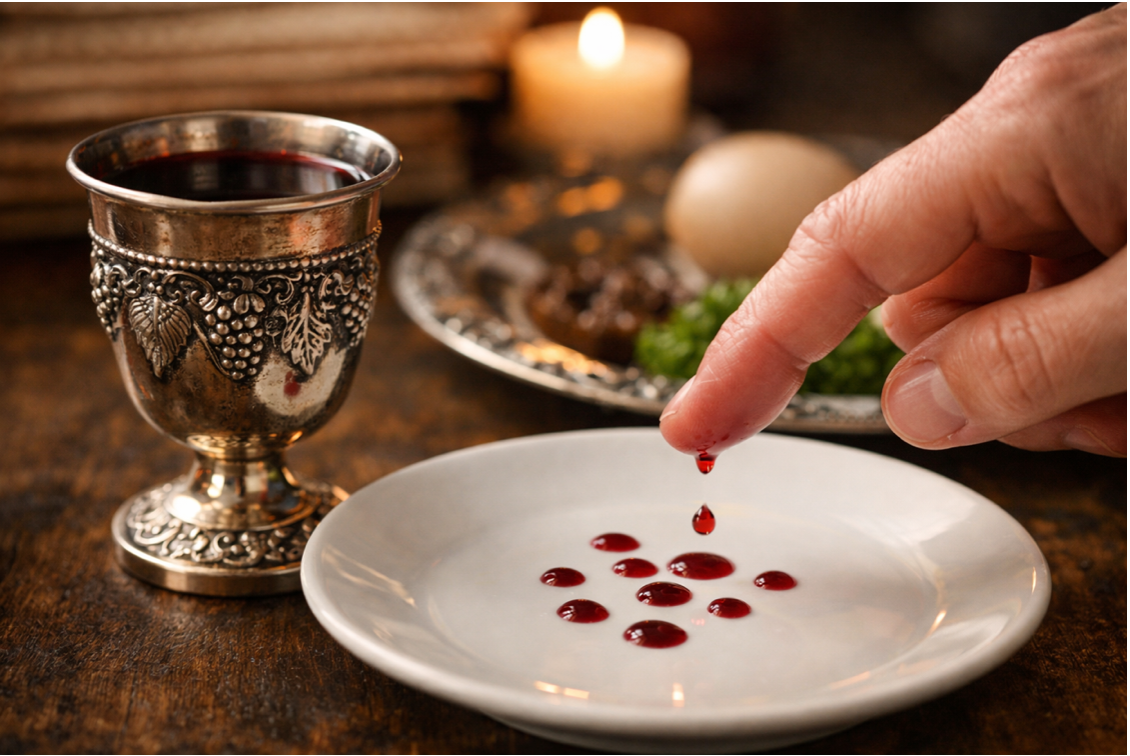
A Diminished Cup: The Seder’s Quiet Rejection of Cruelty
by Greg Bouwer
As Pesach approaches, Jewish families gather to retell the story of the Exodus — the journey from slavery to freedom, from oppression to dignity, from despair to redemption. It is a story that invites celebration. The Seder table reflects this: wine is poured, songs are sung, and gratitude is expressed for liberation.
Yet at the very moment our joy should be fullest, the Seder introduces a striking interruption.
As we recite the Ten Plagues, we remove a drop of wine from our cup for each one.
The result is subtle but deliberate: our cup of joy is diminished.
Why Diminish Joy?
In most historical narratives, the defeat of an oppressor is a cause for unrestrained celebration. The suffering of one’s enemy is framed as triumph — justified, even deserved.
The Seder rejects this instinct.
The plagues were the mechanism through which freedom was secured. They broke the power of a regime that had enslaved an entire people for generations. Yet Jewish tradition insists on something morally uncomfortable but deeply important: even justified suffering is still suffering.
The Egyptians were not abstractions. They were human beings — many of them ordinary people caught inside a system of cruelty they did not choose and could not easily escape.
And so, at the very moment we recount our liberation, we are instructed not to revel in their pain.
The Ethics of Restraint
This ritual reflects a broader and consistent thread within Jewish thought: the refusal to celebrate the suffering of others, even when those others are enemies.
A well-known passage in the Talmud (Megillah 10b) captures this with stark clarity. As the Israelites crossed the sea and the Egyptian army drowned behind them, the angels began to sing. God rebuked them: “My creations are drowning in the sea, and you would sing?”
The message is unmistakable. Justice may be necessary. Victory may be unavoidable. But exultation in human suffering crosses a moral line.
Yet the tradition does not end there.
The Israelites themselves did sing. Shirat HaYam — the Song of the Sea — is one of the great outpourings of joy in the Torah. So the tradition is not forbidding celebration. It is drawing a finer distinction: there is a difference between gratitude for one’s own redemption and pleasure in another’s destruction.
The first is commanded. The second is not.
This distinction runs deep. Proverbs is explicit: “Do not rejoice when your enemy falls, and let your heart not be glad when he stumbles” (24:17).
And it is embedded not only in narrative, but in ritual.
During the final days of Pesach, Jewish liturgy calls for only a partialHallel — the full psalms of praise are deliberately curtailed. The reason given in the Talmud is the same: we do not offer complete songs of joy over the death of God’s creations.
The same principle expressed in ten drops of wine is woven into the structure of the festival itself.
Justice Is Not Vengeance
This is not moral relativism. The Exodus story draws clear distinctions between oppression and liberation, between right and wrong. Pharaoh’s cruelty is not excused. The liberation is unambiguously good.
But the tradition draws a second distinction — one that is easily lost:
Justice is not the same as vengeance, and victory is not a licence for cruelty.
Vengeance finds meaning in the suffering of the other. It feeds on it. Justice does not.
Justice seeks restoration — the protection of the vulnerable, the reestablishment of dignity, the ending of wrongdoing. The suffering of the oppressor may accompany justice, but it is not its goal.
The Seder makes this tangible. We recount the plagues — we do not omit them. But we diminish our cup. We refuse to centre our joy on them.
The emotional centre of the Seder is not the plagues.
It is the freedom.
Holding the Tension
The Seder does not resolve this tension — it preserves it.
We drink four full cups of wine. We sing Dayenu. We express gratitude with almost overwhelming abundance.
And yet our cup is not full.
We pause ten times. We remove ten drops. We acknowledge ten costs.
This is not contradiction. It is moral discipline.
Judaism does not ask us to choose between justice and compassion. It insists that we hold both simultaneously — to celebrate deliverance while remaining conscious of its consequences.
There is a quiet but profound insight here: the capacity to recognise the suffering of an enemy, even while opposing them, is not weakness.
It is what separates a moral actor from a merely powerful one.
A Message That Travels
This ritual speaks with particular force in the world we inhabit.
We live in an age where suffering is no longer distant. It appears in our hands, on our screens — a clip of a family fleeing, a mother clutching a child, a face caught in the moment of loss. And just as quickly, the framing arrives: which side this belongs to, what we are permitted to feel, who deserves our sympathy and who does not.
The pressure is immediate and unforgiving. Empathy becomes conditional. Grief becomes partisan.
The Seder offers a different model.
It does not ask us to abandon moral clarity. The Exodus story is not neutral — it has oppressors and victims.
But it insists that even within a story of clear moral stakes, the humanity of those on the wrong side is not erased.
This is the harder discipline: to resist the reflex to sort suffering into categories, to refuse the satisfaction it can offer, to remain human in our response — even in conflict.
The Cup That Teaches Us Who We Are
The cup of wine at the Seder is meant to symbolise joy — full, overflowing joy.
But it is never completely full.
Ten drops are removed.
And in that small act, repeated year after year, Judaism articulates a profound moral truth:
Our joy is incomplete when it rests upon the suffering of others.
Even in our most justified moments, even in our greatest victories, we are called to remain human.
The diminished cup reflects a deeper tension within the tradition — between justice and restraint, between distance and experience. The following essay explores that tension.