

Passover: When Angels Must Be Silent
When Angels Must be Silent: Distance, Experience, and the Ethics of Response
by Greg Bouwer
In the Pesach Seder, we diminish our cup of wine as we recall the plagues — a ritual acknowledgment that our freedom came at a cost borne by others. It is a discipline of restraint, a refusal to celebrate suffering even when it accompanies justice.
Yet Jewish tradition complicates this ethic in a striking way.
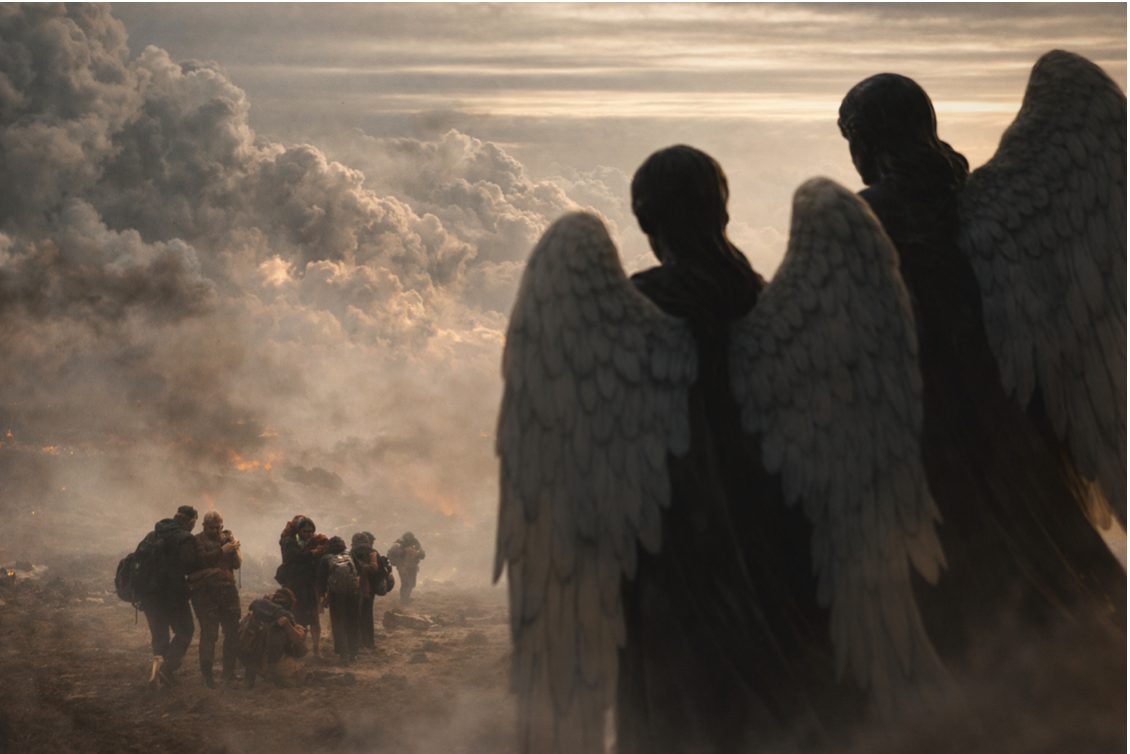
At the very moment of Egypt’s destruction, two responses unfold in parallel. According to the Talmud, when the Egyptian army drowned in the sea, the angels began to sing — and were rebuked: “My creations are drowning in the sea, and you would sing?” (Megillah 10b).
And yet the Israelites themselves, standing on the far shore, burst into song: Shirat HaYam, one of the great hymns of the Torah.
The same event. Two audiences. Two opposite responses.
The angels must be silent. The humans are permitted — even commanded — to sing.
Why?
The Problem of Moral Distance
At first glance, the distinction is puzzling. Angels, in rabbinic thought, are not moral agents in the human sense. They do not act out of malice, pride, or vengeance. If anything, their song is a pure response to divine justice unfolding.
Why, then, are they rebuked?
The answer lies not in what they feel, but in what they lack.
Angels do not suffer. They do not experience oppression, fear, or liberation. They observe history, but they are not participants in it. Their perspective is one of total distance.
And it is precisely that distance that renders their celebration morally inappropriate.
To sing at the destruction of others, while remaining untouched by the conditions that made that destruction necessary, is to risk turning justice into spectacle.
The rebuke is not a denial of justice. It is a rejection of detached triumphalism.
The Moral Authority of Experience
The Israelites, by contrast, are not distant observers. They are former slaves. They have lived the brutality of Egypt — the forced labour, the degradation, the fear.
Their song is not about the suffering of the Egyptians.
It is about the end of their own suffering.
This is the crucial distinction.
Shirat HaYam is not a celebration of death. It is an expression of relief, gratitude, and recognition of deliverance. It is the voice of those who have passed through danger and emerged alive.
Where the angels see destruction, the Israelites experience salvation.
And that experience matters.
Jewish thought, in this reading, does not treat all moral responses as interchangeable. It recognises that proximity to suffering — having endured it — changes what can be rightly expressed.
Gratitude for survival is not the same as pleasure in another’s downfall, even when both arise in response to the same event.
Empathy Without Equivalence
This distinction clarifies a tension that often appears in ethical discourse.
To acknowledge the suffering of an enemy is not to equate them with their victims. It does not erase moral distinctions or deny responsibility. The Exodus narrative remains clear: Egypt enslaved, Israel was enslaved.
But the tradition imposes a further discipline — one that reaches even those with full moral standing.
The Israelites are permitted to sing. Yet even their joy is not unbounded. It is later tempered — through the diminished cup at the Seder, through the partial Hallel that curtails full praise.
This matters.
It means that experience grants moral permission, but does not remove moral responsibility. Even those who have suffered — even those whose liberation is just — are asked to restrain their joy, to acknowledge the humanity of those who suffered in the process.
The distinction, then, is not between those who may celebrate and those who may not. It is between forms of response.
Gratitude is permitted. Triumphalism is not.
The Limits of Witnessing
The rebuke of the angels carries a further implication — one that resonates with particular force today.
Those who are distant from suffering — who encounter it only as observers — are held to a different standard.
The angels’ error is not cruelty. It is abstraction.
They respond to an event without bearing its weight.
This raises an uncomfortable question: what does it mean to witness suffering without experiencing it?
In an age where images of conflict and catastrophe circulate instantly, most of us inhabit precisely this position. We see events unfold in real time, yet we remain physically and existentially removed from them.
We are, in a sense, closer to the angels than to the Israelites.
And that proximity to distance — that paradox — carries ethical consequences.
The Discipline of Response
If the tradition is taken seriously, it suggests that the further one is from suffering, the greater the obligation of restraint.
Those who endure oppression may express relief, even joy, at its end.
Those who observe from afar must be more careful.
Not because justice is unclear. Not because moral distinctions disappear. But because distance creates a risk: the risk of converting human suffering into something consumable — something that can be reacted to, commented on, even celebrated, without cost.
The angels are rebuked not because they are wrong about justice, but because they are untouched by its price.
A Theology of Proximity
Taken together, these strands suggest a broader principle:
Moral response is shaped not only by what happens, but by where one stands in relation to it.
Those who suffer may cry out and may sing. Those who are delivered may give thanks. Those who are distant must exercise restraint.
This is not a hierarchy of worth, but of responsibility.
It recognises that ethical expression is not uniform. It is conditioned by experience, by proximity, by what one has borne and what one has not.
Returning to the Seder Table
This brings us back to the Seder.
The removal of the wine drops, the curtailing of Hallel, the memory of the angels’ rebuke — these are not isolated teachings. They form a coherent moral vision.
Even as participants in the story of liberation, we are asked to step back — to diminish our joy, to acknowledge the suffering of others, to resist the pull of triumph.
We are not angels. We are permitted to sing.
But we are also not permitted to forget.
Between Silence and Song
The tradition does not demand silence. It does not forbid joy. It draws a boundary.
There is a place for song — the song of survival, of gratitude, of redemption. There is also a place for silence — the silence that recognises the cost, that refuses to celebrate destruction, that honours the humanity even of those who stood on the wrong side of history.
To live within that boundary is not simple. It requires holding two truths at once: that justice matters, and that suffering matters. The angels, in their distance, failed to hold both.
The task given to human beings is harder — to know when to sing, and when not to.